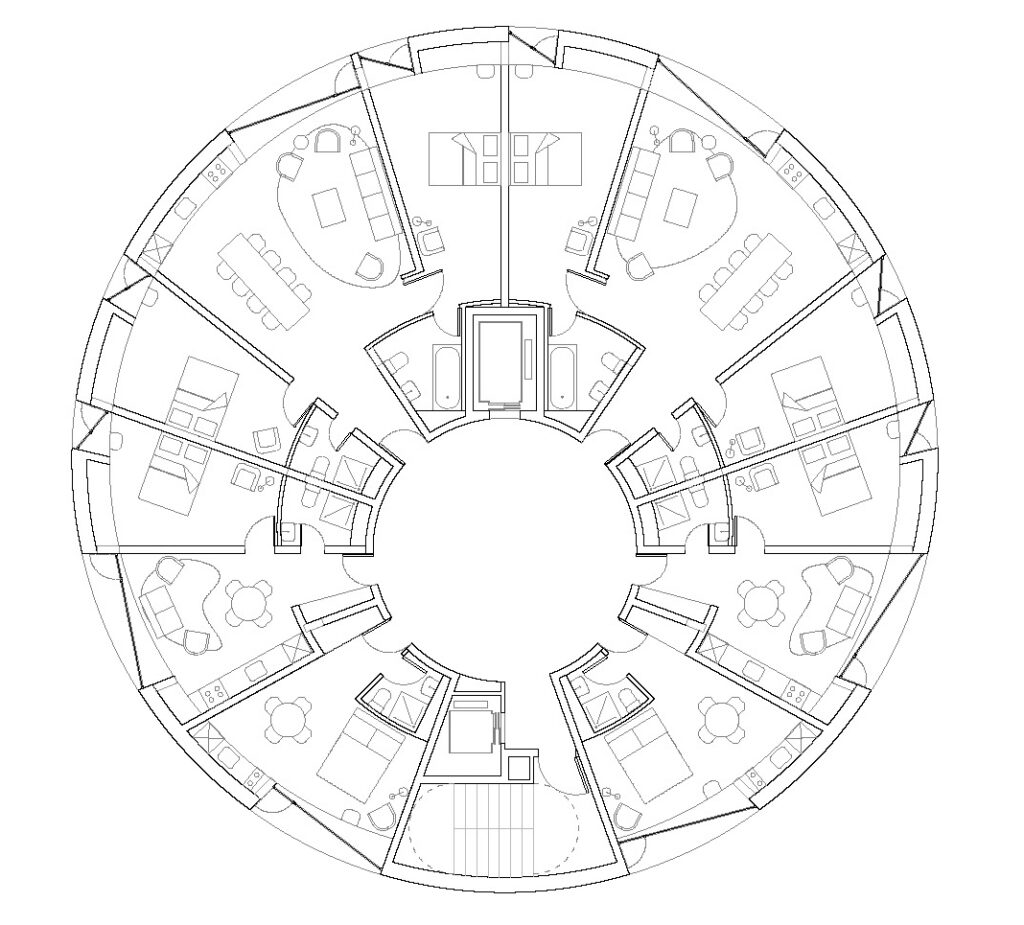
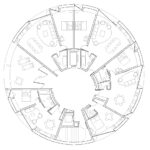
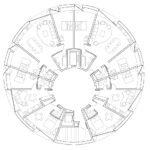
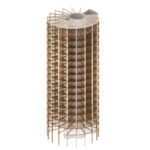
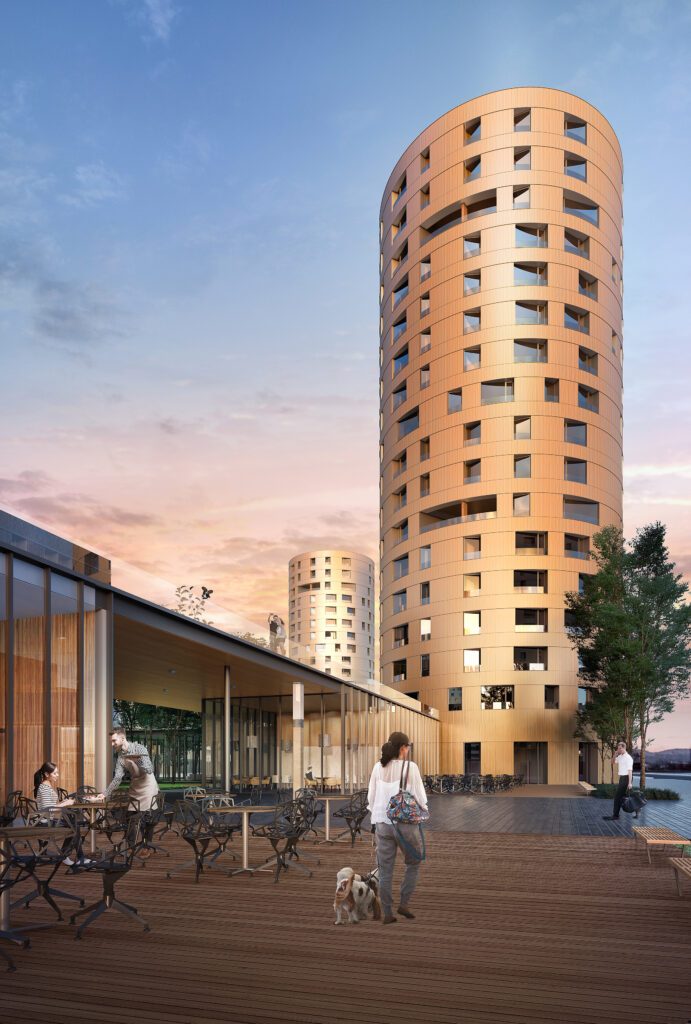
The Jequitibá Building, with 18 floors, approaches the height of the tallest timber buildings constructed worldwide. Therefore, a hybrid timber-concrete structure was carefully designed to withstand vertical and horizontal forces, as well as fire action. In this context, some innovative solutions were proposed.
The circular shape of the building, in addition to providing elegance and lightness, ensures better aerodynamic performance, reducing, for example, the drag coefficient compared to a traditional prismatic building. The bracing system consists of rigid concrete cores in the vertical circulation areas, connected by radial beams to an external shell composed of MLC columns and innovative curved CLT panels, which have been the focus of recent research, such as by Stecher et al. (2016). Thus, the building’s cross-section approximates a tubular section, enhancing the potential for tall construction. We plan to conduct a more detailed verification of this bracing system in later stages of the project through numerical analysis using the finite element method.
Vertical loads are transferred from the CLT-concrete composite slabs to the MLC beams and then discharged into the MLC columns and concrete cores. These loads reach the first floor, which is entirely structured in reinforced concrete, and are subsequently transmitted to the foundations. Regarding structural fire safety, the CLT-concrete composite slabs create fire barriers between floors, and the vertical concrete cores establish protected escape routes. Additionally, the massive timber elements used can be dimensioned to resist fire for extended periods, based on knowledge of the wood’s carbonization rate, considering that the charred layer thermally insulates the interior of the components, maintaining their resistant properties unchanged.
DORMF + STRELKA
This proposal presents three multifamily building projects with significant use of engineered timber structural systems, along with a possible configuration of a typical urban block, also incorporating commercial and community-oriented activities.
The project seeks balance and beauty within the urban fabric, grounded in the appreciation of active streets intensively occupied by pedestrians, which encourage spontaneous encounters and multiple forms of social interaction. The proposal is based on relatively small, porous blocks interwoven with avant-garde architecture. It explores the interiority of the blocks, offering alternative paths that are faster, quieter, and more bucolic, complementing the peripheral sidewalks, which are richly populated with shops and restaurants. A low, linear building connects the residential volumes, helping to shape legible spaces within the block while simultaneously providing areas for commercial and community activities, understood here as essential complements to housing. Above these, residents benefit from generous communal terraces for sunbathing and social interaction. Vegetation plays an important role, not merely as a decorative element, but as an integral part of the landscape, without overshadowing the fundamentally urban and active character of the proposal.
Regarding the architecture, the project respects the plasticity and specific material qualities of each building, defining their expressiveness through subtle manipulations in the arrangement of façade elements. The floor plans are inherently flexible, employing façades not only as systems for daylighting, ventilation, and thermal and acoustic insulation—taking advantage of the excellent thermal properties of CLT—but also as integral components of the structural system, particularly in providing lateral bracing. Façades are also used to accommodate storage, work surfaces, and kitchen counters. The external CLT panels are protected by waterproof membranes and cladding, ensuring greater durability. Wet areas are arranged linearly, rationalizing construction and allowing for expansive free zones dedicated to the primary living spaces of the apartments. This approach ensures flexibility not only for changes in unit layouts, but also for the reorganization of entire floors if necessary, enabling the buildings to accommodate changes of use over a much longer lifespan.
The three proposed buildings prioritize the use of solid timber structural systems, particularly glued laminated timber (glulam) and cross-laminated timber (CLT). External CLT walls are protected with waterproof membranes and clad with sawn timber slats, treated with natural preservatives or using the shou sugi ban technique, which enhances material durability through surface charring. In addition to their thermal and acoustic performance, these walls also contribute, in some cases, to the lateral bracing of the buildings.
All timber elements are protected from rising damp through reinforced concrete foundations and metal connections, which are not detailed at this stage of the project. Non-structural internal partitions are composed of lightweight enclosure systems, framed with sawn timber or LVL studs, incorporating thermal and acoustic insulation and finished with OSB panels and gypsum boards, reinforcing the proposed architectural flexibility.
Vertical circulation cores are concentrated in reinforced concrete shafts, ensuring protected means of egress against the spread of fire. Although solid timber exhibits good structural performance under fire conditions due to the formation of a char layer that preserves its load-bearing core (Pinto, 2001), its combustibility justifies the adoption of these concrete cores, which also make a significant contribution to the lateral stability of the buildings.