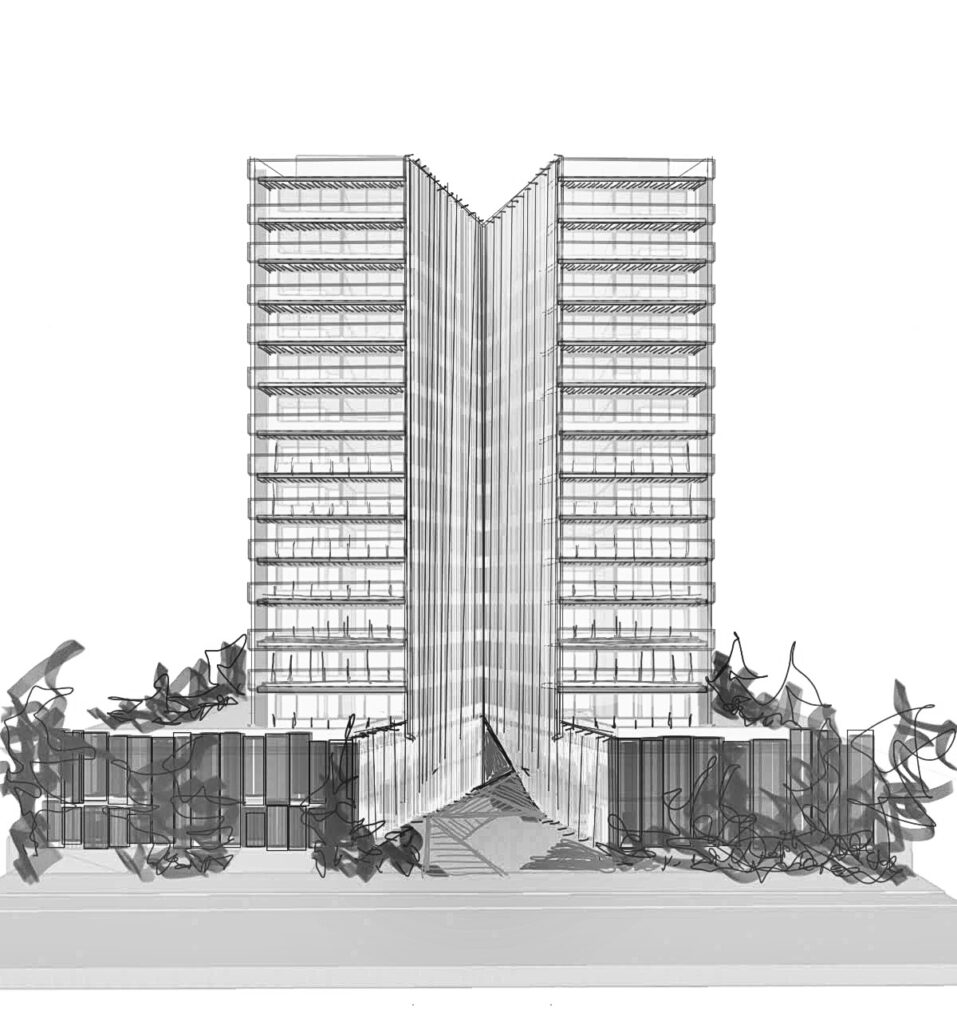
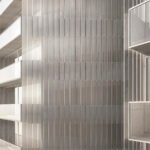
Academic study developed in the Special Projects Studio I course of the Architecture and Urbanism program at Universidade La Salle, in partnership with Woss. The work is grounded in a close reading of the current municipal legal framework, seeking to test the limits imposed by urban regulations and real estate market dynamics, with the aim of expanding design possibilities for contemporary vertical housing.
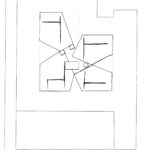
Located in the Menino Deus neighborhood, the proposal prioritizes the enhancement of spatial experience within the units and the expansion of outward views. A less compact volumetric configuration broadens viewing angles from the social areas without compromising privacy between apartments. This formal opening strengthens the building’s relationship with the city and maximizes natural daylight across all spaces, articulating environmental performance with spatial quality.
The formal investigation engages in dialogue with the tradition of constructive sculpture, particularly in the works of Amílcar de Castro, Franz Weissmann, and Jorge Oteiza, as well as with the spatial dimension present in Waltercio Caldas’s work. In the field of painting, it draws from the compositional investigations of Paul Klee and Kenneth Noland. These references do not operate as formal transpositions, but rather as conceptual substrata for the exploration of planes, cuts, voids, and volumetric tensions that structure the design.
The study thus positions itself as a critical reflection on contemporary vertical housing, exploring morphological alternatives capable of reconciling environmental performance, spatial quality, and regulatory feasibility, while questioning recurring development models and proposing new possibilities for the relationship between building and city.